

If you’ve been putting off starting a blog for your pilates studio, med spa, or hair salon because you’re not sure it’s worth the effort, this is your sign to stop waiting. Yes, blogging absolutely helps SEO. But how it helps has gotten more nuanced, and doing it right matters more than ever in 2026.
Search engines have evolved. So have your potential clients. They’re not just typing “pilates studio near me” anymore. They’re asking full questions, comparing options, and looking for businesses that actually know what they’re talking about. A well-written blog is one of the most powerful tools you have to show up for those searches and build trust before someone ever walks through your door.
Here’s what you need to know about blogging and SEO, and why it still works when it’s done with intention.
Blogging Gives Search Engines More to Work With
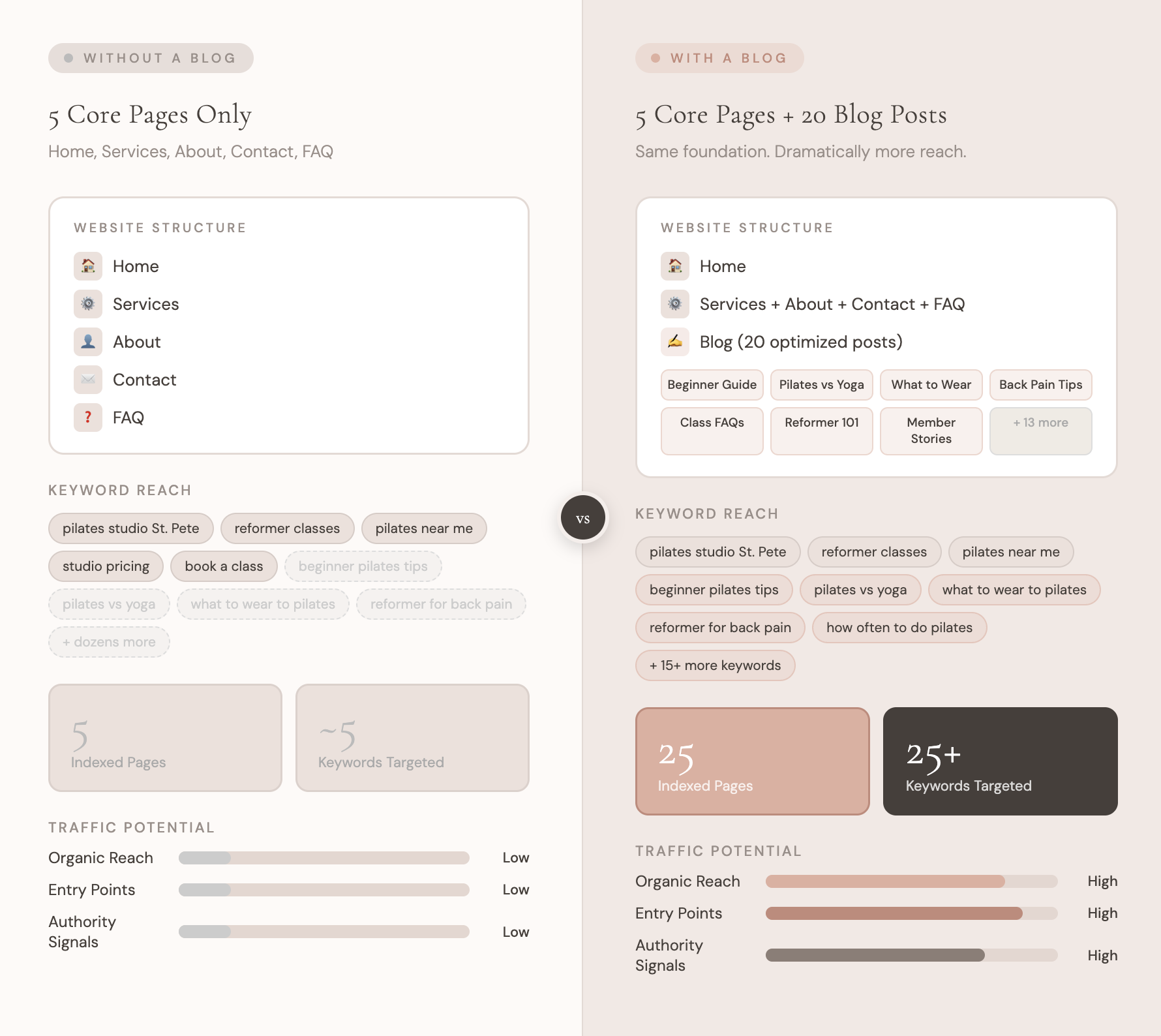
Your website’s core pages (home, services, about, contact) are essential. But they can only target so many keywords before they start feeling stretched thin. A blog fixes that.
Every blog post is a new, indexed page on your website. That means more opportunities to rank for the specific searches your ideal clients are already making. A med spa in St. Pete might rank its homepage for “med spa St. Petersburg FL,” but a blog post can rank for “what is a HydraFacial and is it worth it” or “how often should you get Botox touch-ups.” Those are real questions real people are searching, and if your blog answers them, you show up.
Over time, a library of blog content expands your website’s overall search footprint. More indexed pages means more entry points for new clients to find you. It’s one of the most sustainable ways to grow organic traffic without spending a dollar on ads.
Blogging Builds Topical Authority
Google wants to send its users to websites that genuinely know their subject. One strong signal of expertise is having a lot of relevant, well-organized content on your topic, what SEO professionals call topical authority.
If you run a pilates studio and your website only has a services page, Google has limited information to determine how credible you are on the topic of pilates. But if you have blog posts covering beginner vs. reformer pilates, what to wear to your first class, how pilates compares to yoga for back pain, and the mental health benefits of consistent movement, now you’re building a real content ecosystem.
That depth tells search engines: this business knows pilates inside and out. As a result, all your pages, including your booking or contact page, benefit from that increased authority.
| Content Approach | What Google Sees |
| Only service pages | Limited topical signals |
| Service pages + consistent blog | Strong topical authority, more trust |
| Blog + internal links + optimized pages | Maximum visibility and ranking potential |
Every Blog Post Is a Long-Tail Keyword Opportunity
Short, competitive keywords like “hair salon St. Petersburg” are tough to rank for, especially if you’re up against established businesses with years of SEO behind them. Long-tail keywords are where newer or smaller businesses can really win.
Long-tail keywords are longer, more specific search phrases. They have lower search volume individually, but they also have lower competition and higher intent. Someone searching “balayage vs highlights which is better for brunettes” is much closer to booking an appointment than someone just browsing “hair salon.”
Blogs are the natural home for long-tail keyword content. You can write a post targeting that exact phrase, answer it thoroughly, and earn a top-three ranking without needing to outrank a major competitor’s homepage. Do that consistently across dozens of topics and those small wins compound into serious traffic.
Blogging Supports Your Local SEO Strategy
For small businesses in competitive markets like St. Petersburg, Clearwater, or Tampa, local SEO is everything. Blogging can strengthen your local presence in ways that core service pages simply can’t.
Writing content with local context, mentioning your neighborhood, referencing local events, and addressing the specific needs of your community, signals to Google that you’re a relevant, active local business. A hair studio in St. Pete writing about “the best protective styles for Florida humidity” isn’t just targeting a keyword. It’s also demonstrating local relevance in a way that a generic page never could.
Blog posts can also support your Google Business Profile performance. When searchers find your blog content and then land on your website, that engagement signals to Google that your business is worth surfacing in local results. It’s all connected.
Blogging Creates Internal Linking Opportunities
Internal links, meaning links from one page on your site to another, are a core part of good SEO. They help search engines crawl your site more effectively, distribute page authority across your content, and keep visitors exploring longer.
A blog makes internal linking natural and strategic. A post about “what to expect at your first med spa appointment” can link to your services page. A post on “how SEO works for small businesses” can link back to your homepage or a specific service. A “before and after hair transformation” post can point readers toward your booking page.
Without a blog, your internal link structure is limited to whatever connections exist between your few core pages. With consistent blogging, you’re constantly building new pathways that strengthen your entire site.
Fresh Content Signals an Active, Trustworthy Website
Google’s crawlers revisit websites regularly to check for updates. A site that hasn’t published anything new in two years sends a quiet signal that maybe the business isn’t that active, or that the information might be outdated.
A blog keeps your site fresh. Regular publishing tells search engines your website is alive and worth revisiting. It also gives you a reason to keep people coming back, build an email list, and share valuable content across social media, all of which can drive additional traffic and brand awareness.
You don’t need to post every day or even every week. Consistent, quality content published once or twice a month outperforms sporadic, rushed posts every time.
How AEO Changes the Blogging Game in 2026
Answer Engine Optimization (AEO) is one of the most important shifts in search right now. As AI-powered tools like Google’s AI Overviews and platforms like ChatGPT become common ways people find information, the standard for what makes a great blog post has risen.
AEO means structuring your content so it’s easy for both humans and AI systems to extract clear, direct answers. Think concise answers at the top of each section, well-organized headers, and content that addresses specific questions your audience is actually asking.
For small businesses, this is a huge opportunity. If your blog post answers “does blogging help SEO for small businesses” better than anyone else’s, there’s a real chance your content gets pulled into an AI answer, a featured snippet, or a top search result. That kind of visibility is free, compounding, and incredibly valuable.
This is why at Clementine Creative Studios, our SEO packages include AEO-optimized blog content, because writing for search in 2026 means writing with both people and AI in mind from the start.
What Makes a Blog Post Actually Work for SEO
Not every blog post helps SEO. A post that’s too short, poorly structured, stuffed with keywords, or not genuinely helpful won’t move the needle. Here’s what separates a blog post that ranks from one that doesn’t:
- Targets a specific keyword or question your audience is searching
- Answers that question clearly and early. Don’t make readers dig for the answer
- Uses headers (H2, H3) strategically to organize the content
- Includes internal links to relevant pages on your site
- Is long enough to be thorough. Typically 1,000 to 2,000+ words for competitive topics
- Has an optimized title tag and meta description
- Uses natural language. Write the way people actually talk and search
- Includes a clear call to action. What do you want the reader to do next?
A blog post that checks all of these boxes is doing SEO work every single day, long after you’ve hit publish.
Other Questions Small Business Owners Ask About Blogging and SEO
How long does it take for a blog post to rank on Google?
Most blog posts take anywhere from 3 to 6 months to rank, sometimes longer in competitive markets. SEO is a long-term strategy. The posts you publish today build momentum over time. Consistency matters more than any single post.
How often should I post on my blog for SEO?
Once or twice a month is a strong starting point for most small businesses. Quality always wins over quantity. A well-researched, optimized post published monthly will outperform three rushed, thin posts any day.
Does the length of a blog post matter for SEO?
Yes, generally speaking. Longer, more thorough content tends to rank better because it covers a topic more completely. That said, length should never be padded for its own sake. Every sentence should earn its place.
Can I write my own blog posts or do I need a professional?
You can absolutely write your own, especially if you know your subject well and write conversationally. The challenge is understanding keyword strategy, SEO structure, and what Google is actually looking for. Many small business owners find that having an SEO partner handle blog content frees them to focus on running their business while still getting the ranking benefits.
Do social media and blogging work together for SEO?
Social media doesn’t directly impact Google rankings, but it creates more touchpoints for people to find and share your content. When more people visit and engage with your blog, that signals to Google that your content is worth ranking higher. They complement each other well.
What topics should a pilates studio, med spa, or hair salon blog about?
Think about the questions your clients ask you in person. What do people wonder before their first appointment? What comparisons are they making? Those are your blog topics. An SEO strategy will also surface keyword data to refine and prioritize your content calendar.
When It’s Time to Get Professional Help
If you’ve been trying to maintain a blog but aren’t seeing any traffic growth, or if you haven’t started because it feels overwhelming, that’s a normal place to be. Running a small business is already a full-time job.
A professional SEO partner doesn’t just write content. They research the right keywords for your specific market, structure posts for both humans and search engines, integrate your blog into a broader SEO strategy, and track what’s working so the effort compounds over time.
If your competitors are showing up above you in search results (and some of them probably are), a consistent blog strategy is one of the most effective ways to close that gap without depending entirely on paid advertising.
Blogging Is Still One of the Best SEO Investments You Can Make
The fundamentals haven’t changed. Blogging helps SEO by expanding your keyword reach, building topical authority, supporting local visibility, and giving search engines fresh, structured content to index. In 2026, with AI-powered search changing how people find information, well-written and well-optimized blog content is more valuable than ever.
If you’re a small business owner and you’re ready to turn your website into something that actually works for you, we’d love to talk. Request a free audit from Clementine Creative Studios and let’s figure out exactly where blogging and SEO fit into your growth plan.