

You built something real. Your studio has good energy, great instructors, and clients who love what you do. But if your schedule still has open spots and your waitlist isn’t full, the problem probably isn’t your classes. It’s that not enough people know about you yet.
Pilates studio marketing works when it’s strategic and consistent. The challenge is that most studio owners are already stretched thin. You’re managing instructors, handling bookings, keeping the studio running, and somewhere in there trying to grow. Marketing tends to fall to the bottom of the list, not because you don’t care, but because there are only so many hours in a day.
This post breaks down the pilates studio marketing strategies that actually move the needle, from local SEO and social media to email and your website. Whether you’re doing this yourself for now or getting close to handing it off to someone who specializes in it, here’s what you need to know.
Your Website Is Your Most Important Marketing Tool
Before anything else, your website needs to be doing its job. A lot of pilates studio owners put effort into Instagram or Google ads and then send potential clients to a website that’s slow, outdated, or hard to navigate on a phone. That’s where you lose them.
Your website should accomplish a few things clearly and quickly. It needs to tell visitors who you are, what you offer, where you’re located, and what to do next. If someone lands on your homepage and can’t find your class schedule or a booking button within a few seconds, they’re gone.
Here’s what a high-performing pilates studio website includes:
- A clean, mobile-friendly design (most of your traffic comes from phone)
- A clear call to action on the homepage, like “Book Your First Class” or “Try a Free Intro Session”
- A services or classes page that explains your offerings in plain language
- Instructor bios that show personality and build trust
- Client testimonials or Google review highlights
- A contact page with your address, phone number, and hours
If your website was built a few years ago and hasn’t been updated since, it might be quietly costing you clients. A well-designed site isn’t just about looking good. It’s about converting visitors into bookings, and that’s a strategy, not just aesthetics.
Local SEO Gets You Found by People Who Are Ready to Book
Most people looking for a pilates studio start with a Google search. They type something like “pilates studio near me” or “reformer pilates [city name],” and they click one of the first few results. If you’re not showing up there, you’re invisible to a huge chunk of your potential market.
Local SEO is the process of making sure your studio shows up when people in your area search for what you offer. It involves a few key components.
Google Business Profile
Your Google Business Profile is often the first thing people see before they ever visit your website. It shows up in Google Maps and in the local results section at the top of the page. Keeping this profile complete and active matters more than most studio owners realize.
Make sure your profile includes accurate hours, your address, a link to your website, photos of your space and classes, and a genuine list of services. Regularly asking happy clients to leave a Google review also strengthens your local rankings and builds social proof at the same time.
On-Page SEO for Your Studio’s Location
Your website needs to clearly tell Google where you are and what you do. That means including your city and neighborhood naturally in your page titles, headings, and content. If you’re in South Tampa or downtown St. Pete, say that. Don’t make Google guess.
Blog Content That Targets What Your Clients Are Searching
This is one of the most underused tools in pilates studio marketing. Blog posts that answer specific questions, like “what should I wear to reformer pilates” or “is pilates good for lower back pain,” rank for long-tail keywords that your core service pages can’t capture. Over time, a consistent blog builds your website’s topical authority and brings in steady organic traffic without any ongoing ad spend.
| Marketing Channel | Best For | Cost |
| Google Business Profile | Local discovery, map results | Free |
| On-Page SEO | Ranking for service keywords | Low (one-time) |
| Blog Content | Long-tail keywords, topical authority | Low (ongoing) |
| Google Ads | Fast visibility, new studio launches | Medium-High |
Social Media Marketing for Pilates Studios That Actually Works
Instagram and Facebook are still worth your time if you use them with intention. The studios that grow their following and convert those followers into clients share a few things in common. They post consistently, they show the real experience of being in their studio, and they engage with their audience instead of just broadcasting at them.
What to Post
The content that performs best for fitness and wellness brands tends to be visual, honest, and specific. Here are some content types that work well for pilates studios:
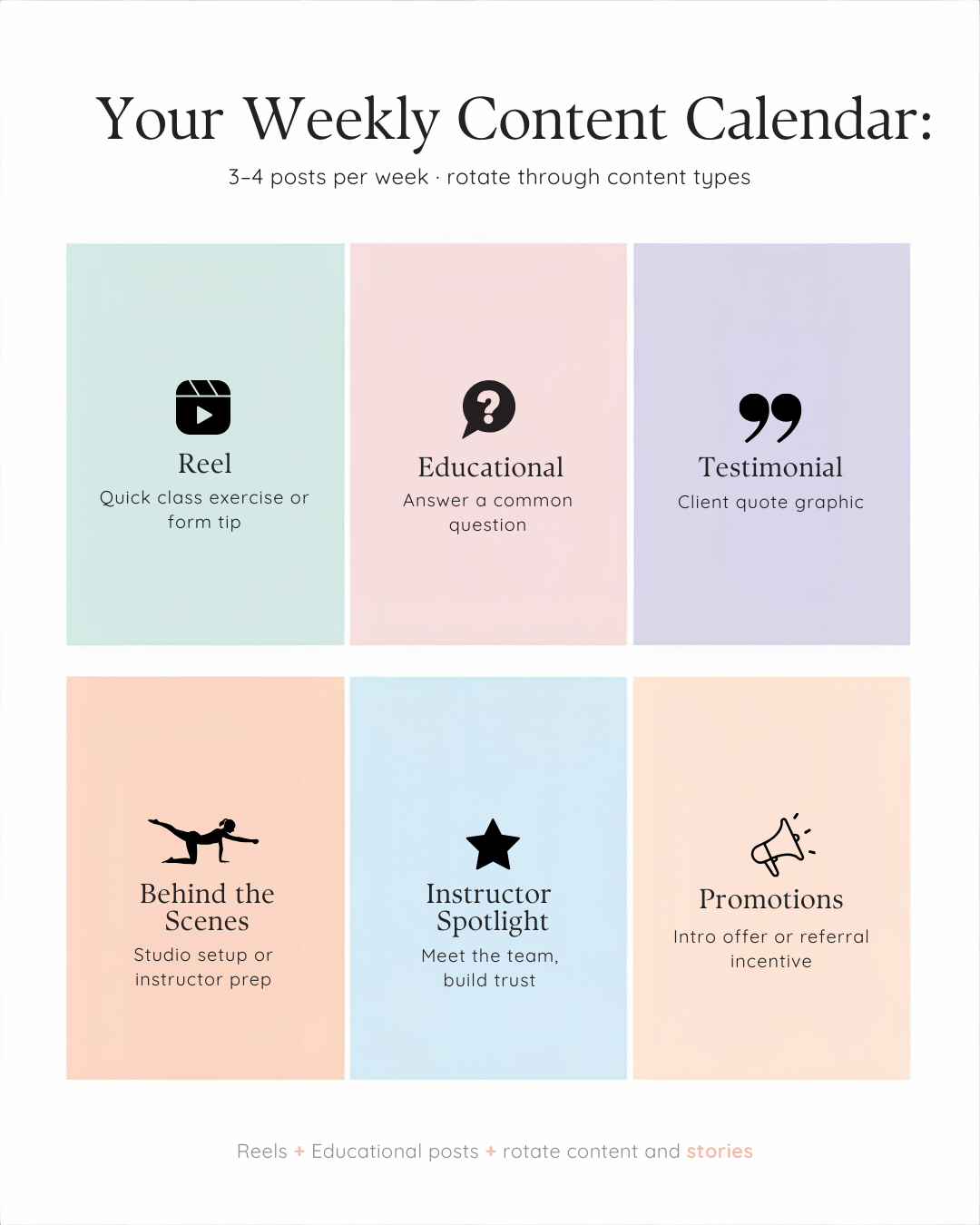
- Short-form video (Reels) showing exercises, transformations, or a day in the studio
- Instructor spotlights that show the people behind the brand
- Client testimonials (with permission) in quote graphic form
- Educational posts about the benefits of pilates, what to expect in a first class, or common questions
- Behind-the-scenes content like studio setup, new equipment, or prepping for a new session format
- Promotions for intro packages, seasonal specials, or referral incentives
Consistency Over Volume
You don’t need to post every day to build an audience. Three to four strong posts per week, paired with genuine engagement in your comments and DMs, will outperform daily posts that feel rushed or generic. Showing up regularly matters more than showing up constantly.
Paid Social for Growth
Organic social is important for building community, but paid placements on Instagram and Facebook can accelerate growth when used strategically. A well-targeted ad promoting a new client intro offer to women aged 25 to 55 within a 10-mile radius of your studio can bring in a wave of first-time visitors at a relatively low cost. Boosted posts and dedicated ad campaigns work best when paired with a strong landing page or website that’s ready to convert that traffic.
Email Marketing Keeps Your Current Clients Coming Back
New client acquisition gets most of the attention in studio marketing, but retention is where the real profitability lives. Industry data shows that loyal customers spend 67% more than new clients. Keeping an existing client costs far less than winning a new one, and email is one of the best tools for keeping your community engaged and your studio top of mind.
Even a simple monthly email newsletter can make a difference. Use it to share class schedule updates, promote upcoming workshops or events, highlight a featured instructor, or offer a loyalty incentive for members who refer a friend. Keep the tone warm and personal, write like you’re talking to someone who already loves your studio, because you are.
What to Include in Studio Email Marketing
- A monthly schedule reminder or any schedule changes
- Upcoming special classes, workshops, or events
- Health and wellness tips related to pilates and movement
- Seasonal promotions or limited-time offers
- Member spotlight or community recognition
- A simple, clear CTA like “Book Your Spot” or “Grab the Last Few Seats”
Email platforms like Mailchimp, Klaviyo, or whatever is built into your booking software make this manageable even if you’re not tech-savvy. The key is to actually use it consistently rather than only emailing your list when you have something to sell.
Your Brand Has to Match the Experience You Deliver
A lot of pilates studios underestimate how much branding affects marketing results. Branding isn’t just your logo. It’s the visual and verbal identity of your studio, the colors, fonts, photography style, the way you write your class descriptions, and the overall feeling someone gets when they land on your website or scroll through your Instagram profile.
When your branding is cohesive and polished, it signals professionalism. It makes people trust you before they’ve ever set foot in your studio. When it’s inconsistent, mismatched, or generic, it quietly undermines the confidence your potential clients need to book that first class.
Studio owners who invest in professional branding find that their marketing starts working harder. Better-looking content gets more saves and shares. A more polished website converts more visitors. A clear brand voice makes it easier to create content because you already know the tone you’re going for.
If your current branding was thrown together quickly when you launched and hasn’t been revisited since, it might be worth looking at whether it’s actually reflecting the level of experience you’re delivering inside your studio.
Referral Programs and Community Partnerships
Word of mouth has always been one of the most powerful marketing channels for local fitness businesses, and it doesn’t have to be purely organic. A simple referral program that rewards current clients for bringing in new ones can drive real growth without a big marketing budget.
Keep it easy and genuinely valuable. A free class credit, a discount on a package, or a small gift for every new client a member refers is enough to motivate participation. The key is making sure your current clients know the program exists and reminding them about it consistently.
Community partnerships are another underutilized strategy for pilates studios. Think about other wellness businesses in your area, physical therapists, chiropractors, acupuncturists, yoga studios, or even local running groups. A simple cross-promotion, a flyer in their space, a joint event, or a social shoutout, can put your studio in front of an audience that’s already interested in health and movement.
Other Questions Pilates Studio Owners Ask About Marketing
How much should a pilates studio spend on marketing? There’s no single right answer, but a common benchmark for small service businesses is to allocate between 5 and 10 percent of gross revenue to marketing. For a studio just starting out or in a competitive market, you might lean toward the higher end. The more important question is whether your marketing dollars are going toward strategies that you can actually track and optimize.
Should I run Google Ads or Facebook Ads for my pilates studio? Both can work, and they serve slightly different purposes. Google Ads put you in front of people who are actively searching for a pilates studio right now. Facebook and Instagram ads are better for building awareness among people who might not be searching yet but fit your ideal client profile. If budget is limited, Google Ads often deliver faster, more measurable results for local service businesses.
How long does it take for SEO to work for a pilates studio? Most studios start seeing meaningful organic traffic gains within three to six months of consistent SEO work, though competitive markets can take longer. SEO is a long game. The work you put in today builds on itself over time, which is why starting sooner rather than later makes a real difference.
Do I need a separate landing page for my intro offer? If you’re running paid ads, yes. Sending paid traffic to your homepage is inefficient. A dedicated landing page with one clear offer, focused copy, and a single call to action will convert significantly better than a homepage that’s trying to do everything at once.
What’s the most common marketing mistake pilates studio owners make? Trying to do everything at once without a clear strategy. Studio owners often bounce between social media, ads, email, and SEO without a cohesive plan, which leads to inconsistent results and burnout. Picking two or three channels, executing them well, and tracking what’s working is almost always more effective than doing everything halfway.
Should I outsource my pilates studio marketing or do it myself? This depends on where you are in your business. Early on, doing it yourself makes sense while you’re learning what resonates with your audience. But as your studio grows, your time becomes your most valuable resource. Outsourcing to a marketing partner who understands wellness brands and local SEO means your marketing runs consistently, strategically, and without you having to think about it every day.
When to Get Professional Help With Your Marketing
If any of these situations sound familiar, it might be time to bring in a professional:
- You’ve been posting on social media but not seeing any growth or bookings from it
- Your website traffic is low or you don’t really know what your traffic looks like
- You’re running ads but not sure if they’re actually making money
- Your schedule has open spots you can’t seem to fill
- Marketing keeps getting pushed to the bottom of your to-do list
- You feel like you’re guessing rather than following a real strategy
A marketing partner who specializes in working with wellness and fitness businesses doesn’t just take tasks off your plate. They bring the strategy, the structure, and the expertise to make your marketing compound over time. You get to focus on what you’re actually great at, running an incredible pilates studio, while someone else handles getting more people in the door.
Your Marketing Should Work as Hard as You Do
Great pilates studio marketing isn’t about chasing every trend or being on every platform. It’s about showing up consistently where your ideal clients already are, with a clear message and a brand that reflects the experience you deliver.
Start with a strong website and solid local SEO. Build an email list and use it. Create social content that shows the real energy of your studio. And when you’re ready to hand all of that off and focus on your clients instead, that’s a completely reasonable and smart next step.
At Clementine Creative Studios, we work with wellness businesses, including pilates studios, to build digital presences that actually grow. From branding and web design to SEO and content strategy, we handle the marketing so you can handle the movement.