

If your small business has a website and social media but you’re still not getting found online, the issue probably isn’t effort. It’s the lack of a plan behind that effort. Content strategy services give small businesses a clear, focused roadmap for what to publish, where to publish it, and why it matters for growth.
Without a strategy, most small businesses end up posting randomly, writing blog content that doesn’t target anything specific, and spending time on social media with very little to show for it. A content strategy changes that. It connects every piece of content you create to a real business goal, whether that’s booking more appointments, ranking higher in local search, or building trust with potential clients before they ever reach out.
Here’s what content strategy services actually include, how they work, and why they matter for businesses like yours.
What Content Strategy Services Actually Are
Content strategy services are not just blog writing. They are the planning, research, and structure behind everything your business publishes online. Think of it as the blueprint that keeps your content focused, consistent, and tied to your goals.
A content strategist looks at your business, your audience, your competitors, and the search landscape, then builds a plan around what will actually move the needle. That plan typically includes keyword research, topic planning, content calendars, brand messaging guidelines, and performance tracking.
For a small business, this is especially valuable because your time and budget are limited. You can’t afford to spend hours creating content that doesn’t reach anyone or doesn’t align with what your ideal client is searching for. Content strategy services make sure every piece of content earns its place.
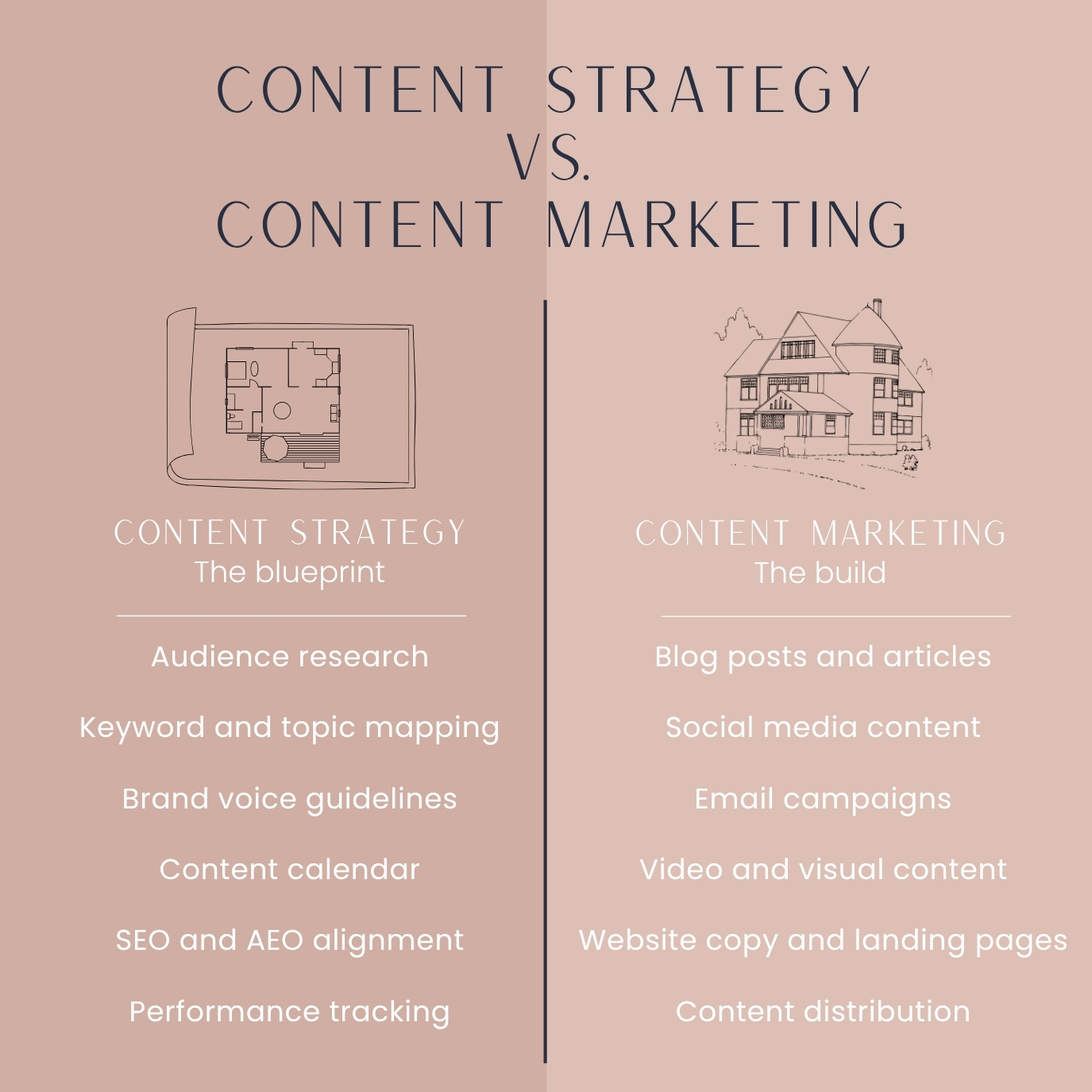
How Content Strategy Differs from Content Marketing
These two terms get used interchangeably, but they’re not the same thing. Content strategy is the plan. Marketing is the execution of that plan.
Content strategy answers the bigger questions. Who is your audience? What are they searching for? What topics should you cover? How does your content support your SEO, branding, and business goals? How do you organize and maintain it over time?
Content marketing is the actual creation and distribution. It’s writing the blog post, designing the Instagram carousel, sending the email newsletter.
You need both. But strategy has to come first. Without it, content marketing becomes guesswork. You end up publishing things that feel productive but don’t connect to a broader growth plan.
| Content Strategy | Content Marketing | |
|---|---|---|
| Focus | Planning, research, structure | Creation, distribution, promotion |
| Goal | Align content with business objectives | Attract and engage your audience |
| Scope | Big picture, long-term | Campaign-level, ongoing |
| Output | Content roadmap, topic clusters, brand voice guidelines | Blog posts, social media, emails, videos |
Why Small Businesses Need a Content Strategy
Small businesses, especially in industries like wellness, beauty, and health services, face a unique challenge. You’re competing for attention in a crowded local market while also trying to build trust with people who have never heard of you.
A content strategy gives you an edge because it helps you focus on the right things instead of spreading yourself thin across every platform and topic.
Here’s what it does for your business in practical terms:
- It helps you rank for the searches that matter
A content strategy built around keyword research identifies the exact phrases your potential clients use when searching. Instead of guessing what to blog about, you’re writing content that targets real search demand. That’s how a med spa in St. Petersburg starts showing up for searches like “best facial for acne-prone skin” or a pilates studio ranks for “reformer pilates for beginners near me.” - It builds topical authority over time
When you publish content around a focused set of topics, search engines start to see your website as an authority on those subjects. A hair studio that consistently publishes content about color care, styling tips, and treatment comparisons builds a content ecosystem that supports every page on the site. - It keeps your messaging consistent
Without a strategy, your website might say one thing, your Instagram another, and your email something different. A content strategy includes brand voice and messaging guidelines so everything feels cohesive, no matter where someone encounters your business. - It saves you time and money
Instead of scrambling to come up with a post idea the night before, you work from a calendar that was planned weeks or months ahead. You know exactly what to create, when to publish it, and how it fits into the bigger picture. For a small business owner already wearing ten hats, that kind of clarity is a game changer.
What’s Included in Professional Content Strategy Services
Not all content strategy services are created equal, and what you get depends on the provider. But a solid content strategy engagement for a small business typically includes the following.
Audience and competitor research
Understanding who your ideal client is, what they’re searching for, and what your competitors are already ranking for. This research shapes every decision that follows.
Keyword research and topic mapping
Identifying the high-value keywords and questions your business should target, then organizing them into topic clusters. This is the foundation for your blog, service pages, and any other content on your site.
Content calendar development
A structured plan that outlines what content will be published, when, and on which platform. This takes the guesswork out of content creation and keeps your publishing schedule consistent.
Brand voice and messaging guidelines
Documented guidelines that ensure every piece of content sounds like your business, whether it’s written by you, your team, or an outside partner.
SEO integration
Content strategy and SEO go hand in hand. Your strategy should include how content supports your on-page optimization, internal linking, local SEO, and even Answer Engine Optimization so your business is positioned for both traditional search results and AI-powered answers.
Performance tracking and refinement
A strategy isn’t a set-it-and-forget-it document. It includes tracking content performance over time and adjusting the plan based on what’s working and what isn’t.
How Content Strategy Supports Your SEO
If your business already has an SEO strategy in place, or you’re thinking about starting one, content strategy is what makes SEO actually work long-term.
SEO without a content plan is limited to your existing pages. You can optimize your homepage and service pages, but those can only target so many keywords. A content strategy expands your reach by identifying topics and long-tail keywords that your core pages can’t cover.
Each blog post you publish as part of your strategy becomes a new indexed page on your site. That means more opportunities to rank, more entry points for potential clients, and more internal linking opportunities that strengthen your overall site structure.
Content strategy also supports local SEO in a big way. For businesses in the Tampa Bay area, writing content with local context, like mentioning specific neighborhoods, referencing local events, or addressing region-specific concerns like Florida humidity and its effect on hair or skin, signals to Google that your business is a relevant local result.
And with the rise of AI-powered search, having well-structured, answer-first content is more important than ever. A content strategy built with AEO in mind positions your content to be pulled into featured snippets, AI Overviews, and other prominent search placements.
Signs Your Business Needs Content Strategy Services
Not every business realizes they need a content strategy until they’ve already spent months creating content that isn’t working. Here are some signs it might be time to invest in professional help.
You’re posting on social media regularly but not seeing growth in followers, engagement, or website traffic. You have a blog but the posts aren’t ranking or driving any meaningful traffic. Your website looks great but doesn’t generate leads or bookings. You feel overwhelmed by content creation and don’t know what to prioritize. Your competitors consistently show up above you in search results. You’ve invested in SEO but don’t have a clear content plan to support it.
If any of that sounds familiar, a content strategy is likely the missing piece. It’s not about creating more content. It’s about creating the right content with intention behind it.
What to Look for in a Content Strategy Partner
Choosing the right partner matters. Here are a few things to consider when evaluating content strategy services for your small business.
Do they take time to understand your business?
A good content strategist doesn’t use a one-size-fits-all template. They learn your industry, your audience, and your goals before building a plan.
Do they integrate content with SEO?
Content and SEO should work together. If a provider is offering content planning without keyword research, competitor analysis, or on-page optimization, the strategy will have gaps.
Do they track results?
A strategy without measurement is just a wish list. Your partner should be monitoring content performance and adjusting the plan based on real data.
Do they understand your local market?
For small businesses, local relevance matters. A partner who understands the Tampa Bay area and how local search works will build a more effective strategy than one working from a generic national playbook.
Other Questions Small Businesses Ask About Content Strategy
How much do content strategy services cost for a small business? Pricing varies depending on the scope and depth of work involved. Some businesses need a one-time strategy buildout, while others benefit from ongoing monthly support. Most small business content strategy services fall within a range that is comparable to what you might spend on paid ads, with the added benefit that the content keeps working for you long after it’s published.
How long does it take to see results from a content strategy? Content strategy is a long-term investment. Most businesses start seeing measurable improvements in search visibility, traffic, and engagement within three to six months. The content you publish today compounds over time, so the sooner you start, the faster the results build.
Can I build a content strategy on my own? You can, especially if you know your audience well. The challenge is that effective strategy requires keyword research tools, competitor analysis, and an understanding of how search engines evaluate content. Many business owners find it more efficient to partner with a professional so they can focus on running their business.
What’s the difference between a content strategy and a content calendar? A content calendar is one component of a content strategy. It tells you what to publish and when. A full strategy goes deeper. It includes audience research, keyword mapping, messaging guidelines, SEO alignment, and performance tracking. The calendar is the schedule. The strategy is the reason behind every item on that schedule.
Do I need a content strategy if I already have an SEO plan? Yes. SEO tells search engines your site is technically sound and relevant. Content strategy ensures you’re consistently publishing the kind of content that supports those SEO goals. Without fresh, strategic content, your SEO performance will eventually plateau.
Is content strategy only about blogging? Not at all. While blogging is often a major part of a content strategy, the plan can also cover your website copy, social media, email marketing, video content, and even printed materials. It’s about how all of your content works together to support your business.
When to Bring in a Professional
If you’ve been handling your own content and feel like you’ve hit a ceiling, or if you haven’t started because the whole thing feels overwhelming, that’s a completely normal place to be. Running a small business doesn’t leave a lot of room for content planning on top of everything else.
A professional content strategy partner does the heavy lifting. They research your market, identify the topics and keywords that will actually drive traffic, build a plan you can execute consistently, and track what’s working so the strategy improves over time.
If your competitors are consistently outranking you, if your blog isn’t generating traffic, or if your content feels scattered and disconnected from your business goals, a content strategy is one of the most practical investments you can make.
Your Content Should Work as Hard as You Do
A beautiful website and a strong service offering will only get you so far if nobody can find you. Content strategy services give your business the roadmap it needs to show up consistently in search results, build trust with potential clients, and turn online visibility into real bookings and revenue.
If you’re ready to stop guessing and start growing with a plan behind your content, we’d love to help. Request a free audit from Clementine Creative Studios and let’s build a strategy that fits your business, your audience, and your goals.