

Picture this. A potential client opens ChatGPT and types, “What’s the best pilates studio in St. Pete?” The AI responds with a tidy little list of three or four studios. Is yours on it? Or is the AI quietly recommending your competitor down the street?
This is the new reality of search. Customers are asking AI tools the same questions they used to type into Google, and they’re getting direct recommendations instead of a list of links. So is it possible to track brand mentions in AI search? Yes, and this guide walks you through exactly how to do it without needing a developer or a giant marketing budget.
Whether you run a hair salon, a med spa, a boutique fitness studio, or any local business, knowing where you stand in AI search results is becoming as important as knowing your Google ranking.
Is It Possible to Track Brand Mentions in AI Search?
Yes, it is possible to track brand mentions in AI search. The methods just look a little different from traditional SEO tracking.
Here’s the catch. AI tools like ChatGPT and Gemini don’t give you a clean ranking dashboard. Their answers are also a bit unpredictable. Ask the same question twice and you may get two slightly different responses with different businesses named. That’s because AI models are probabilistic, which is a fancy way of saying they don’t always pull the same answer from the same drawer.
Still, you have two solid options for tracking. You can spot-check manually by running real customer questions through the major AI platforms and writing down what you see. Or you can use paid tools that automate the process and watch trends over time.
The four AI platforms that matter most for small local businesses right now are:
- ChatGPT (where many people now ask everyday questions)
- Google AI Overviews (the AI-generated answers at the top of Google search)
- Gemini (Google’s standalone AI tool)
- Perplexity (popular for research and recommendations)
Why Tracking AI Brand Mentions Matters for Small Businesses
This is not just a big-brand concern. AI search is reshaping how everyday people discover local services, and small businesses feel the impact first.
Think about how often you’ve asked Siri, Google, or ChatGPT a quick question lately. Now imagine your customers doing the same thing when they’re looking for a haircut, a facial, or a pilates class. The business AI mentions wins the click, the visit, and often the booking.
At Clementine Creative Studios, we’ve started hearing something new on discovery calls with potential clients. People are saying things like, “I asked ChatGPT for studios near me and your name came up,” or “AI recommended your post on hydrafacials.” That kind of inbound interest didn’t exist a year ago. It’s a real shift, and it’s happening fastest in the industries our small business clients work in, like wellness, beauty, and fitness.
Tracking your AI mentions tells you three things that matter:
- Whether real customers are seeing your name when they ask AI
- Which competitors are getting recommended instead of you
- What kind of content is helping your brand show up
That information shapes everything from your content strategy to your local SEO work.
What Actually Counts as a Brand Mention in AI Search
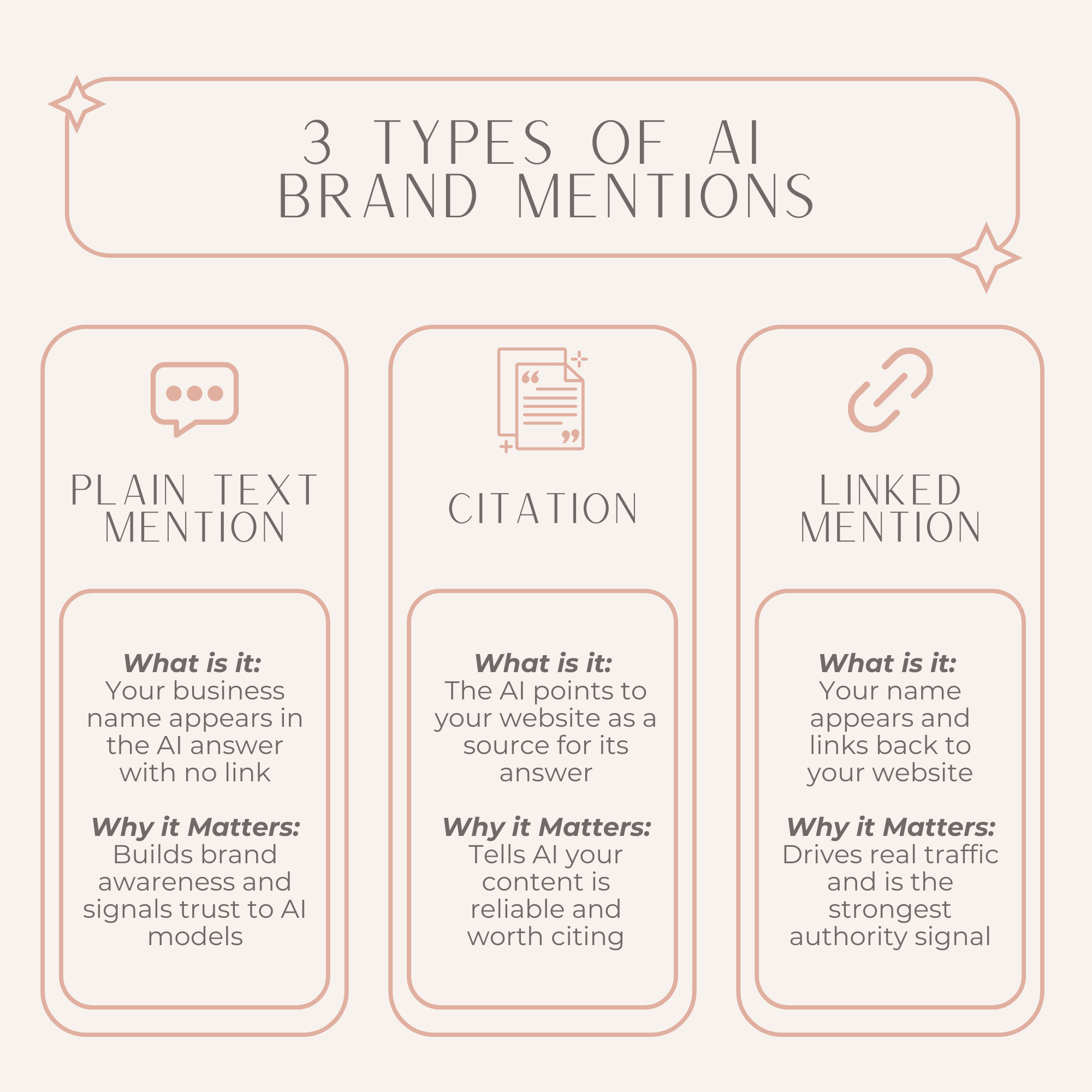
Not every AI mention looks the same. Before you start tracking, it helps to know what you’re looking for.
Mentions vs. Citations vs. Links
Here’s a quick breakdown:
| Type of Mention | What It Looks Like | What It Means For You |
|---|---|---|
| Plain-text mention | Your business name appears in the AI’s answer with no link | Builds brand awareness and signals trust to AI models |
| Citation | The AI points to your website as a source for its answer | Tells AI your content is reliable and worth surfacing |
| Linked mention | Your name appears AND links back to your site | Drives actual traffic and the strongest authority signal |
Why All Three Matter
Even an unlinked mention is a win. AI models notice when your brand shows up across multiple trusted places, and that pattern shapes future recommendations. So if a friend asks ChatGPT, “Who do people recommend for lash extensions in Tampa?” and your name appears (even without a link), that’s a signal you’re doing something right.
How to Track Brand Mentions in AI Search Results Step by Step
You don’t need fancy software to start. Here’s a simple process any small business owner can do in an afternoon.
Step 1: Make a List of Real Customer Questions
Think about how your customers actually talk. They’re not searching with marketing language. They’re asking real, casual questions.
For a pilates studio, that might look like:
- “What’s the best pilates studio in [your city]?”
- “Where can I take a beginner reformer class near me?”
- “Top-rated pilates instructors in [your neighborhood]”
For a med spa:
- “Best place for botox in [your city]?”
- “Affordable hydrafacial near me”
- “Top-rated med spa for first-timers”
Aim for 10 to 20 prompts. Do not include your business name in the prompt. The whole point is to see if AI brings you up on its own.
Step 2: Run Each Prompt Across the Major AI Platforms
Open ChatGPT, Gemini, Perplexity, and run a Google search to see the AI Overview. Plug in each prompt one by one. Take notes on which AI tools name your business and which don’t.
A pro tip: ask the same question 2 or 3 times. AI answers vary, so one test isn’t enough.
Step 3: Record What You See in a Simple Tracker
A basic spreadsheet does the job. Set up columns like this:
- Prompt
- Platform (ChatGPT, Gemini, etc.)
- Did your brand appear? (Yes/No)
- Competitors named
- Notes (sentiment, context, anything notable)
Step 4: Look for Patterns Over Time
Check back once a month. Look for:
- Prompts where you consistently show up (those are your wins)
- Prompts where you never show up (your gaps)
- Competitors who keep getting named (your benchmarks)
Over time, you’ll see trends that point to where to focus your content and SEO efforts.
Free Ways to Check Your AI Visibility This Week
You don’t need to spend a dollar to get started. Here’s a quick free audit you can do in about 30 minutes.
- Run prompts in ChatGPT using the free tier
- Try the same prompts in Gemini and Perplexity
- Search Google for your top customer questions and see what shows up in the AI Overview at the top of the page
- Set up Google Alerts for your business name to track web mentions that might feed AI models
- Check your Google Business Profile to make sure your info is accurate, since AI tools often pull from this
The free approach works well for a starting snapshot. It gets harder to manage once you want to track dozens of prompts every month, which is when paid tools start to make sense.
Paid Tools That Make Tracking Easier
If you want to track AI mentions without spending hours each month, paid tools can save serious time. Several platforms now monitor brand mentions across ChatGPT, Gemini, Perplexity, and Google AI Overviews automatically.
When choosing a tool, look for these features:
- Multi-platform tracking so you can see mentions across all the major AI tools in one place
- Sentiment tracking to know if your brand is being described positively, neutrally, or negatively
- Competitor benchmarking so you can compare your visibility to similar businesses
- Historical data to spot trends over weeks and months
- Easy-to-read dashboards because pretty data is data you’ll actually use
For most small businesses, a $30 to $50 per month tool is plenty. You don’t need an enterprise platform built for Fortune 500 brands. You need something simple, accurate, and easy to check.
What to Do When Your Brand Is Not Showing Up:
If your AI audit comes back light, don’t panic. AI search is still new, and most small businesses are figuring this out together. Here’s how to start improving your visibility.
Strengthen the Content AI Sources Trust
AI models pull from helpful, well-structured content. That means:
- Blog posts that answer real customer questions in plain language
- Service pages that clearly explain what you offer, where, and for whom
- FAQ sections on your website that mirror how people actually ask things
We’ve seen Clementine clients land in AI Overview answers within a few months of publishing well-optimized service pages and blog clusters. Consistent, helpful content is the long game, and it works.
Get Mentioned in Trusted Places
AI models trust sources that have authority across the web. Work on:
- Getting featured in local press or community blogs
- Partnering with complementary businesses for co-marketing content
- Earning listings in respected industry directories
- Encouraging happy clients to leave detailed reviews on Google and Yelp
Make Your Website Easier for AI to Read
Technical signals matter too. Some basics to check:
- Add schema markup so search engines understand your services
- Keep page load times fast (mobile speed especially)
- Use real photos and clear headings
- Build internal links between related pages
If you’re not sure where to start, our content strategy services are built specifically to help small businesses show up in places like AI search and local SEO.
How Often Should You Check Your AI Search Mentions?
Once a month is plenty for most small businesses. If you’re in a competitive market like med spas in a major city or hair salons in a dense neighborhood, every two weeks is smart.
Each check-in, look for:
- New prompts you should be tracking
- Shifts in who’s getting recommended
- Changes in how AI describes your business
Block 30 minutes on your calendar, run your prompts, update your tracker, and move on with your day. That’s it.
Related Questions
Can I track brand mentions on ChatGPT specifically?
Yes. You can manually run prompts in ChatGPT and record whether your business appears, or use a paid tool that automates ChatGPT tracking across thousands of queries. ChatGPT is one of the most important AI platforms to monitor right now because of how widely it’s used.
Does AI search use the same ranking factors as Google?
Not exactly. AI search pulls from a mix of signals including content quality, brand mentions across the web, citations from trusted sources, and structured data. Traditional Google SEO still matters, but AI weighs trust signals and natural-language content more heavily.
How long does it take to start showing up in AI search results?
Most small businesses see early results within three to six months of consistent content and SEO work. The exact timeline depends on your industry, location, and how competitive your market is.
Do small local businesses really get mentioned in AI search?
Yes, and often more than people expect. AI tools regularly recommend specific local businesses by name, especially when someone asks for the “best” or “top” option in a city or neighborhood. That’s why local SEO and content strategy are now part of AI visibility.
What is the difference between AI search and SEO?
Traditional SEO focuses on ranking your website in search engine results. AI search visibility focuses on whether AI tools mention your brand directly in their answers. The two overlap, but AI search adds new factors like brand mentions, citations, and how easily AI can summarize your content.
Need Help Showing Up in AI Search?
Tracking your AI mentions is the first step. Building the kind of content, website structure, and brand presence that gets you mentioned in the first place is where the real work happens.
That’s exactly what we do at Clementine Creative Studios. We help small businesses like pilates studios, med spas, salons, and wellness brands build content and SEO strategies that show up where customers are actually searching, including AI search results.
If you’re ready to stop wondering whether AI is recommending your business and start making sure it does, reach out for a content and SEO consultation. We’d love to help you build a brand presence that works just as hard as you do.